The Hook System
Hooks are the primary value proposition of TransformerLens. They let you intercept, cache, edit, or ablate intermediate activations as a model runs — without modifying the model code. This page covers the user-facing API; for the implementation, see transformer_lens/hook_points.py.
What a hook is
A HookPoint is an nn.Identity module placed at a named position inside a model (e.g., blocks.0.attn.hook_q). At runtime it passes its input through unchanged — but a registered hook function can read the tensor (caching), modify it (intervention), or replace it (ablation, patching).
The hook system is purely PyTorch’s register_forward_hook / register_full_backward_hook underneath, but with two additions that matter:
Named positions. Every hook point has a string name like
blocks.{i}.hook_resid_post, so you can address it without traversing the module tree.Context-scoped lifecycle. Hooks added inside a
with model.hooks(...)context auto-remove when the block exits — no manual cleanup required.
Three ways to use hooks
1. run_with_cache — read everything
The simplest workflow: run a forward pass and get back both the logits and a dict of every cached activation, keyed by hook name.
logits, cache = model.run_with_cache("Hello, world")
cache["blocks.0.attn.hook_q"]           # Q tensor at layer 0
cache["blocks.5.hook_resid_post"]       # residual stream after block 5
cache["ln_final.hook_normalized"]       # final norm output before its learned gain
cache is an ActivationCache — a dict-like with conveniences (cache.decompose_resid(), cache.apply_ln_to_stack(...), etc.). See transformer_lens/ActivationCache.py.
For TransformerBridge:
from transformer_lens.model_bridge import TransformerBridge
bridge = TransformerBridge.boot_transformers("gpt2", device="cpu")
logits, cache = bridge.run_with_cache("Hello, world")
Pass names_filter= to cache only a subset (saves memory):
logits, cache = model.run_with_cache(
    "Hello, world",
    names_filter=lambda name: name.endswith("hook_resid_post"),
)
Pass incl_bwd=True to also cache gradients. This runs backward() on the output, so the
run must return a scalar (return_type="loss"); gradients land under a _grad suffix:
loss, cache = model.run_with_cache(
    "Hello, world",
    return_type="loss",
    names_filter="blocks.0.attn.hook_pattern",
    incl_bwd=True,
)
cache["blocks.0.attn.hook_pattern"]        # attention probabilities
cache["blocks.0.attn.hook_pattern_grad"]   # d(loss) / d(attention probabilities)
Pass pos_slice= to keep only some positions, which cuts cache memory on long prompts. It
takes an index, a (start, stop) or (start, stop, step) tuple, or a list of indices, and
applies to gradients as well:
logits, cache = model.run_with_cache("Hello, world", pos_slice=-1) # final position only
2. run_with_hooks — intervene during the forward pass
Attach temporary hooks for one forward pass, then auto-remove them.
def zero_out_head_3(activation, hook):
    activation[:, :, 3, :] = 0   # ablate attention head 3
    return activation

logits = model.run_with_hooks(
    "Hello, world",
    fwd_hooks=[("blocks.5.attn.hook_z", zero_out_head_3)],
)
Each hook is a (hook_name, hook_fn) tuple. The hook function signature is always:
def hook_fn(tensor: torch.Tensor, *, hook: HookPoint) -> Optional[torch.Tensor]:
    # Read or modify `tensor`. Return None to leave the activation unchanged,
    # or return a tensor of the same shape to replace it.
    ...
hook (the HookPoint instance) exposes hook.name so a single function can dispatch on which hook called it.
For backward hooks (gradient interventions), use bwd_hooks=[...] with the same tuple shape.
3. add_hook + remove_all_hook_fns — manual lifecycle
When you need hooks that persist across multiple forward passes (e.g., during training), drop down to the underlying API:
hook_point = model.blocks[5].attn.hook_z
hook_point.add_hook(my_hook_fn, dir="fwd")           # temporary
hook_point.add_hook(my_hook_fn, dir="fwd", is_permanent=True)  # survives reset

# later
model.remove_all_hook_fns()                          # removes temporary hooks
model.remove_all_hook_fns(including_permanent=True)  # also removes permanent
add_hook returns nothing useful; lifecycle is owned by the HookPoint. The is_permanent flag is the only way to survive a remove_all_hook_fns() call.
Hook naming
Stable strings; differ between HookedTransformer and TransformerBridge:
System |
Style |
Example |
|---|---|---|
|
Uniform across architectures |
|
|
Architecture-native canonical names, plus the HT-style names as aliases of the same hook points |
|
Full catalogue: Main Demo, Exploratory Analysis Demo. Architecture diagram: TransformerLens_Diagram.svg.
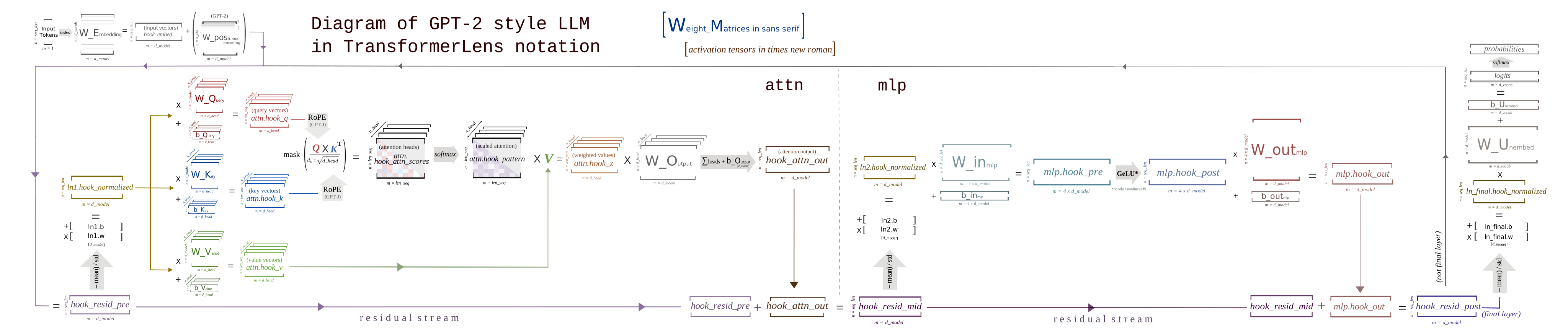
Porting HT code to Bridge: the HT-style names already resolve on every bridge (see Model Structure for the alias table and the hooks that are not aliases). Enable bridge.enable_compatibility_mode() (see Compatibility Mode) when the analysis needs HookedTransformer’s processed-weight numerics, not for the names.
Common patterns
Cache one activation, run a single forward pass
logits, cache = model.run_with_cache("text", names_filter="blocks.5.hook_resid_post")
resid_5 = cache["blocks.5.hook_resid_post"]
Zero-ablate a head
def ablate(z, hook):
    z[:, :, head_idx, :] = 0
    return z

model.run_with_hooks("text", fwd_hooks=[(f"blocks.{layer}.attn.hook_z", ablate)])
Activation patching (swap an activation from one prompt into another)
_, clean_cache = model.run_with_cache(clean_prompt)
target = clean_cache["blocks.5.hook_resid_post"]

def patch(resid, hook):
    return target   # replace corrupted's activation with clean's

logits = model.run_with_hooks(
    corrupted_prompt,
    fwd_hooks=[("blocks.5.hook_resid_post", patch)],
)
transformer_lens/patching.py wraps this pattern for systematic sweeps across layers / positions.
Gradient intervention via backward hook
def scale_grad(grad, hook):
    return grad * 0.1

model.run_with_hooks(
    "text",
    bwd_hooks=[("blocks.5.hook_resid_post", scale_grad)],
)
Lifecycle gotchas
Temporary hooks added outside
run_with_hooks/model.hooks(...)do NOT auto-clean. Callmodel.remove_all_hook_fns()or you’ll leak hooks across runs.Permanent hooks (
is_permanent=True) surviveremove_all_hook_fns()— useincluding_permanent=Trueto clear them.Hook functions that return a tensor replace the activation in-flight. Returning
Noneleaves it unchanged. In-place modification (tensor[…] = …) +return tensoris the common pattern.Backward hooks see
(grad,)tuples at the PyTorch level — the wrapper inhook_points.pyunwraps to a bare tensor for you. Your hook function still receives a bare tensor.Hooks fire in registration order, with
prepend=Trueto register at the front.
See also
Compatibility Mode — when a Bridge model needs HookedTransformer-equivalent numerics.
Migrating to TransformerLens 3 — porting HookedTransformer hook patterns to TransformerBridge.
Main Demo — end-to-end walkthrough using the hook system.
transformer_lens/hook_points.py,transformer_lens/ActivationCache.py,transformer_lens/patching.py— source.