TransformerBridge Model Structure
This page describes the structure exposed by TransformerBridge, the canonical hook names to use, and the expected tensor shapes at each hook point.
Overview
TransformerBridge wraps a Hugging Face model behind a consistent TransformerLens interface. It relies on:
An ArchitectureAdapter that understands the HF module graph and provides a mapping to bridge components
Generalized components (Embedding, Attention, MLP, Normalization, Block) exposing uniform hook points
A light aliasing layer for backwards compatibility with legacy TransformerLens hook names
Construct a bridge from a HF model id:
from transformer_lens.model_bridge import TransformerBridge

bridge = TransformerBridge.boot_transformers("gpt2", device="cpu")
You can then call the familiar APIs: to_tokens, to_string, generate, generate_stream, run_with_hooks, run_with_cache.
Architecture diagram
The diagram below maps weight matrices and activation tensors to their TransformerLens names. Hook points sit on the activation arrows — the canonical hook names in the rest of this document correspond directly to the labeled tensors here.
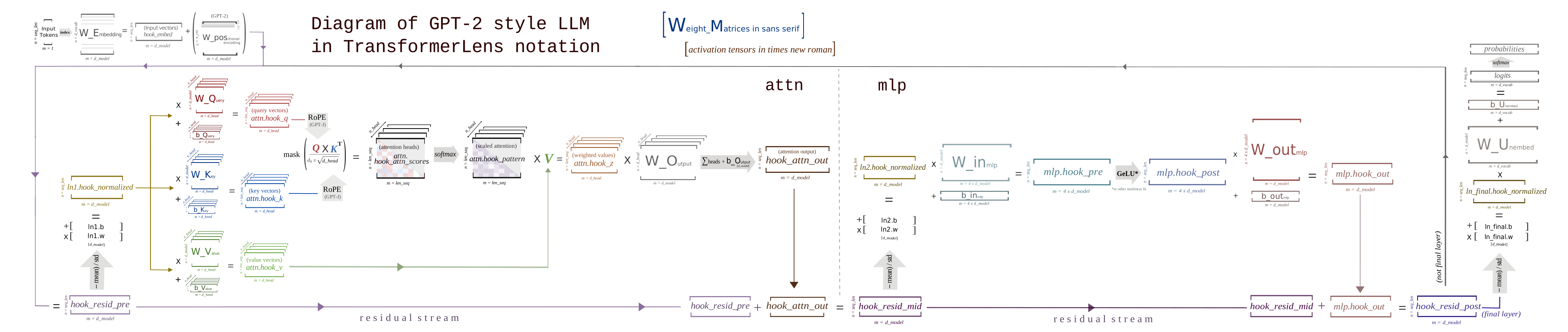
Diagram by Austin Kozlowski. Click for full resolution.
Top-Level Components
Typical decoder-only models expose these top-level components (names vary by architecture):
embed: token embeddingpos_embed(if applicable) or rotary embeddings inside attentionblocks: list-like container of transformer blocksln_final(if applicable): final normalizationunembed: output projection to vocabulary logits
Each blocks.{i} is a BlockBridge with subcomponents:
ln1: normalization before attentionattn: attention moduleln2: normalization before MLPmlp: MLP module
Canonical Hook Names
Use these canonical names when adding hooks or reading from the cache. Every name below exists on every TransformerBridge from boot, and the legacy HookedTransformer names in the alias table resolve to the same HookPoint objects whether or not compatibility mode is enabled.
Hook names fall into three groups, and it matters which group a name belongs to:
Canonical hooks: the
hook_in/hook_outpair on every component, plus the named intermediates listed here.Aliases: a legacy name bound to the same
HookPointas a canonical name. Same tensor, same shape, one firing.Flag-gated legacy hooks:
HookPoints that carry a legacy name but are not aliases of any canonical hook. They capture a different tensor and fire only when the matching config flag is set:blocks.{i}.hook_mlp_in,blocks.{i}.hook_attn_in,blocks.{i}.hook_q_input/hook_k_input/hook_v_input, andblocks.{i}.attn.hook_result.
Embedding
embed.hook_in: token ids (batch, pos)embed.hook_out: token embeddings (batch, pos, d_model). Alias:hook_embed.pos_embed.hook_in/pos_embed.hook_out: learned positional embeddings, (batch, pos) / (batch, pos, d_model). Alias:hook_pos_embed. Rotary models have nopos_embedcomponent; seehook_rot_q/hook_rot_kunder attention.
Residual stream
blocks.{i}.hook_in: residual stream into the block (batch, pos, d_model). Alias:blocks.{i}.hook_resid_pre.blocks.{i}.ln2.hook_in: residual stream after the attention output is added back (batch, pos, d_model). Alias:blocks.{i}.hook_resid_mid. This is the sum, not the attention branch output (blocks.{i}.attn.hook_out).blocks.{i}.hook_out: residual stream out of the block (batch, pos, d_model). Alias:blocks.{i}.hook_resid_post.
Attention
blocks.{i}.attn.hook_in: the sublayer’s argument, i.e.blocks.{i}.ln1.hook_out(batch, pos, d_model). Not an alias ofblocks.{i}.hook_attn_in, which is flag-gated and per-head (below).blocks.{i}.attn.q.hook_in/blocks.{i}.attn.k.hook_in/blocks.{i}.attn.v.hook_in: input to each projection (batch, pos, d_model)blocks.{i}.attn.q.hook_out/blocks.{i}.attn.k.hook_out/blocks.{i}.attn.v.hook_out: projected heads (batch, pos, n_heads, d_head); K and V use n_key_value_heads under grouped-query attention. Aliases:blocks.{i}.attn.hook_q,blocks.{i}.attn.hook_k,blocks.{i}.attn.hook_v.blocks.{i}.attn.hook_rot_q/blocks.{i}.attn.hook_rot_k: rotary models only; Q and K after the rotation, same shapes ashook_q/hook_k.blocks.{i}.attn.hook_attn_scores: pre-softmax scores (batch, n_heads, pos, pos)blocks.{i}.attn.hook_pattern: post-softmax pattern (batch, n_heads, pos, pos). There is no hook named hook_attention_weights.blocks.{i}.attn.o.hook_in: per-head values weighted by the pattern (batch, pos, n_heads, d_head). Alias:blocks.{i}.attn.hook_z.blocks.{i}.attn.o.hook_out: output projection (batch, pos, d_model)blocks.{i}.attn.hook_out: attention branch output (batch, pos, d_model). Alias:blocks.{i}.hook_attn_out. On architectures with a post-attention norm (Gemma 2 / 3),hook_attn_outaliasesblocks.{i}.ln1_post.hook_outinstead, matching whereHookedTransformerplaced it.blocks.{i}.attn.hook_hidden_states: fused-QKV bridges only (GPT-2 family); fires on the tensor thatattn.hook_outreceives, immediately before it. Rotary attention bridges do not fire it. It is not an alias ofhook_result.
Flag-gated attention hooks. Each exists on every bridge but fires only when its flag is set; all are (batch, pos, n_heads, d_model), with n_key_value_heads for the K/V inputs:
blocks.{i}.attn.hook_attn_in(aliasblocks.{i}.hook_attn_in): the pre-ln1residual replicated per head, with the norm applied per head afterwards. Gated bycfg.use_attn_in(bridge.set_use_attn_in(True)).blocks.{i}.attn.hook_q_input/hook_k_input/hook_v_input(aliasesblocks.{i}.hook_q_inputetc.): the same per-head pre-ln1fork, one copy per projection. Gated bycfg.use_split_qkv_input(bridge.set_use_split_qkv_input(True)). Not aliases ofq.hook_inetc.blocks.{i}.attn.hook_result: per-head attention output before the sum over heads. Gated bycfg.use_attn_result(bridge.set_use_attn_result(True)).
MLP
blocks.{i}.mlp.hook_in: the sublayer’s argument, i.e.blocks.{i}.ln2.hook_out(batch, pos, d_model). This is not the legacyhook_mlp_in; see below.blocks.{i}.mlp.hook_pre: pre-activation (batch, pos, d_mlp). Alias ofblocks.{i}.mlp.in.hook_out. On gated MLPs (SwiGLU / GeGLU) it aliasesblocks.{i}.mlp.gate.hook_out, andblocks.{i}.mlp.hook_pre_linearaliasesblocks.{i}.mlp.in.hook_out, the ungated branch.blocks.{i}.mlp.hook_post: post-activation, the input to the output projection (batch, pos, d_mlp). Alias ofblocks.{i}.mlp.out.hook_in.blocks.{i}.mlp.hook_out: MLP branch output (batch, pos, d_model). Alias:blocks.{i}.hook_mlp_out. On architectures with a post-MLP norm,hook_mlp_outaliasesblocks.{i}.ln2_post.hook_outinstead.blocks.{i}.hook_mlp_in(flag-gated, on the block): the MLP-branch entry point, which isln2’s input on pre-norm blocks (the same tensor ashook_resid_mid) and the MLP’s own input on post-norm blocks. Gated bycfg.use_hook_mlp_in(bridge.set_use_hook_mlp_in(True)), matching legacyHookedTransformer. It sits one norm earlier thanmlp.hook_inand is not an alias of it or ofmlp.hook_pre.
Normalization
blocks.{i}.ln1.hook_in: the norm’s input (batch, pos, d_model)blocks.{i}.ln1.hook_scale: the per-token denominator, (batch, pos, 1):sqrt(var + eps)of the centered input for LayerNorm, of the raw input for RMSNormblocks.{i}.ln1.hook_normalized:x / scalebefore the learned gain and bias (batch, pos, d_model)blocks.{i}.ln1.hook_out: the module’s output, gain and bias applied (batch, pos, d_model)
These are four distinct tensors; none is an alias of another. hook_scale and hook_normalized keep their legacy HookedTransformer meaning (ActivationCache.apply_ln_to_stack divides by the cached hook_scale). Legacy HookedTransformer had no post-gain hook, so hook_out has no legacy equivalent. The same four hooks exist on ln2, ln_final, and on post-sublayer norms (ln1_post / ln2_post) where an architecture has them.
Unembedding / Logits
unembed.hook_in: (batch, pos, d_model)unembed.hook_out: logits (batch, pos, d_vocab). Alias:hook_unembed.
Legacy alias table
Each row is checked against a tiny GPT-2 bridge and a tiny Gemma 3 bridge by tests/unit/model_bridge/test_model_structure_doc.py. To resolve an alias on a live bridge, read bridge.hook_dict[name].name.
Legacy name |
Resolves to |
Note |
|---|---|---|
|
|
|
|
|
|
|
|
|
|
|
|
|
|
the residual sum, not |
|
|
|
|
|
|
|
|
|
|
|
|
|
|
|
|
|
|
|
|
|
|
|
|
|
|
|
|
|
flag-gated, per-head; not |
|
|
flag-gated, per-head; not |
|
|
flag-gated, per-head; not |
|
|
flag-gated, per-head; not |
Not aliases of anything: blocks.{i}.hook_mlp_in and blocks.{i}.attn.hook_result are their own flag-gated HookPoints; hook_normalized and hook_scale on every norm are distinct tensors from that norm’s hook_out; blocks.{i}.attn.hook_hidden_states is its own hook.
Shapes at a Glance
Residual stream and hidden states: (batch, pos, d_model)
Attention scores and patterns: (batch, n_heads, pos, pos)
Q/K/V projections and
hook_z: (batch, pos, n_heads, d_head)Flag-gated per-head inputs and
hook_result: (batch, pos, n_heads, d_model)MLP pre- and post-activation: (batch, pos, d_mlp)
Embeddings: (batch, pos, d_model)
Unembedding logits: (batch, pos, d_vocab)
Norm
hook_normalized: (batch, pos, d_model); normhook_scale: (batch, pos, 1)
These shapes are exercised in the multi-model shape test: tests/integration/test_hook_shape_compatibility.py.
Booting from Hugging Face
TransformerBridge.boot_transformers(model_id, ...):
Loads the HF config/model/tokenizer
Selects the appropriate ArchitectureAdapter
Maps HF config fields to TransformerLens config (e.g.,
d_model,n_heads,n_layers,d_mlp,d_vocab,n_ctx, …)Constructs the bridge and registers all hook points
Fused QKV Attention
Some architectures use a fused QKV projection (GPT-2, GPT-Neo, Bloom, MPT). The bridge’s JointQKVAttentionBridge splits the joint weight at setup into the same q / k / v sub-bridges that split-projection models expose, so blocks.{i}.attn.q.hook_out, the hook_q / hook_k / hook_v / hook_z aliases, hook_attn_scores and hook_pattern all work identically. Fused-QKV bridges additionally fire blocks.{i}.attn.hook_hidden_states on the attention output. The joint projection’s own blocks.{i}.attn.qkv.hook_in / blocks.{i}.attn.qkv.hook_out exist but sit off the live path and never fire.
Aliases and Backwards Compatibility
Legacy names are registered at boot on every bridge and resolve to the same HookPoint as their canonical target, so cache["blocks.0.hook_resid_pre"] and cache["blocks.0.hook_in"] are one tensor. enable_compatibility_mode() changes the numerics (folded and centered weights, matching HookedTransformer), not the set of names; the flag-gated hooks need their flag in either mode. New code should prefer the canonical names documented here. See compatibility mode for the weight-processing contract.
Example: Caching and Inspecting Hooks
prompt = "Hello world"
logits, cache = bridge.run_with_cache(prompt)

# List some attention-related hooks on the first block
for k in cache.keys():
    if k.startswith("blocks.0.attn"):
        print(k, cache[k].shape)
For larger examples and a multi-model shape check, see tests/integration/test_hook_shape_compatibility.py.